Foundations of Everyday Communication
General Objective of PART 1
This first part of the A2 course bridges A1 to A2 and focuses on practical, real-life communication.
You consolidate essential grammar and vocabulary to function independently in common daily situations, especially those tested in the TEF A2 (listening, reading, writing, and speaking).
By the end of this part, you can understand, interact, and produce simple but structured messages related to your personal life and immediate environment.
Communication Skills (Speaking / Listening / Reading / Writing)
1. Talking about Yourself
You develop the ability to:
- Introduce yourself clearly
- Talk about:
- studies or professional life
- family members
- your neighborhood or living area
TEF alignment:
1. Personal presentation (spoken & written)
2. Short oral responses
3. Simple descriptive texts
2. Hobbies & Daily Activities
You learn to:
- Describe daily routines (weekday/weekend)
- Talk about hobbies and leisure activities
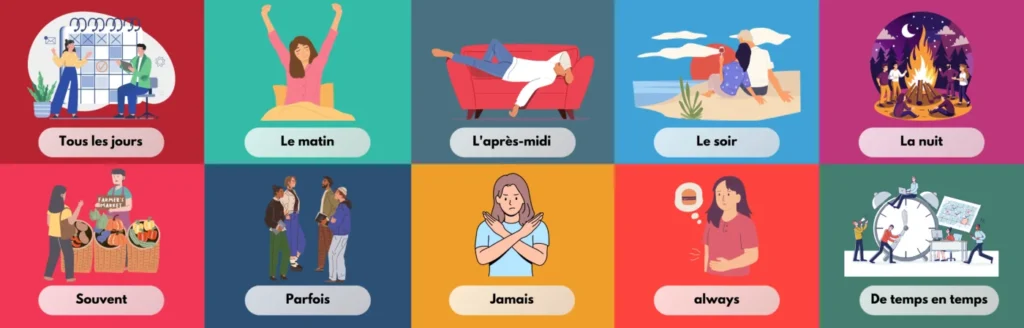
- Express frequency (often, sometimes, every day)
Skills trained:
- Listening to short daily-life dialogues
- Speaking using the present tense
- Writing short paragraphs (40–60 words)
3. Reading Everyday Texts
You practice understanding:
- Notices and public signs
- Posters and advertisements
- Menus and simple announcements
TEF focus:
1. Identify key information
2. Understand context without translating word-by-word
4. Writing Functional Messages
You write:
- Short notes (reminders, instructions)
- Simple messages (SMS, WhatsApp-style, emails)
- Clear instructions using basic verbs
Examples:
- Leaving a note at home
- Giving simple instructions to someone
5. Shopping & Asking for Goods
You practice:
- Asking for items in a shop
- Referring to visible/displayed objects
- Using polite requests
Functional language:
- “Je voudrais…”
- “Combien ça coûte ?”
- “Il y a… ?”
TEF relevance:
1. Role-play speaking tasks
2. Everyday transactional language
Grammar Focus
1. Revision of A1 Essentials
A structured revision of:
- Present tense
- Subject pronouns
- Basic sentence structure
- Articles (un/une/le/la/des)
Purpose: accuracy before complexity
2. Verbes Pronominaux (Reflexive & Reciprocal)
You learn to:
- Use verbs like se lever, se laver, s’appeler
- Understand daily routines through reflexive verbs
- Identify reciprocal meaning (se rencontrer)
3. Common High-Frequency Verbs
Focused practice on:
- aller (movement, future plans)
- venir (origin, arrival)
- mettre (clothing, placement)
- prendre (food, transport, decisions)
4. Modal Verbs + Infinitive
You use:
- vouloir → expressing desire
- pouvoir → ability / permission
- devoir → obligation
Example structure:
Subject + verb + infinitive
5. Il faut + Infinitive
Used to:
- Express general rules and necessity
- Give advice or instructions
Common in notices, rules, and instructions — very frequent in TEF texts
6. Adjectives: Position & Agreement
You practice:
- Masculine / feminine forms
- Singular / plural agreement
- Common adjective placement (before/after noun)
Vocabulary Themes
You build usable A2-level vocabulary in these areas:
- Family & physical description
- Daily activities & routines
- Objects of daily life
- Food, meals & basic shopping
Vocabulary is always taught:
1. in context
2. with audio
3. with sentence-level practice
Learning Outcome (End of PART 1)
By the end of this module, you can:
- Communicate confidently in everyday situations
- Describe yourself and your routine
- Interact in shops and public places
- Understand simple written and spoken texts
- Use the present tense and near future accurately
Outcome:
Confident everyday communication — ready for A2 progression and TEF tasks